









 There is a growing uneasiness rippling across Black communities and immigrant households in the United States – an uneasiness that is neither fleeting nor imagined. It is rooted in lived experience, history, and the sobering data emerging from institutions like the Pew Research Center. Pew confirms what many of us have long felt: 63% of Black adults say being Black hurts their ability to get ahead in America, and a majority believe the country is moving backward on issues of race and justice. That is not pessimism; that is lived reality affirmed by research.
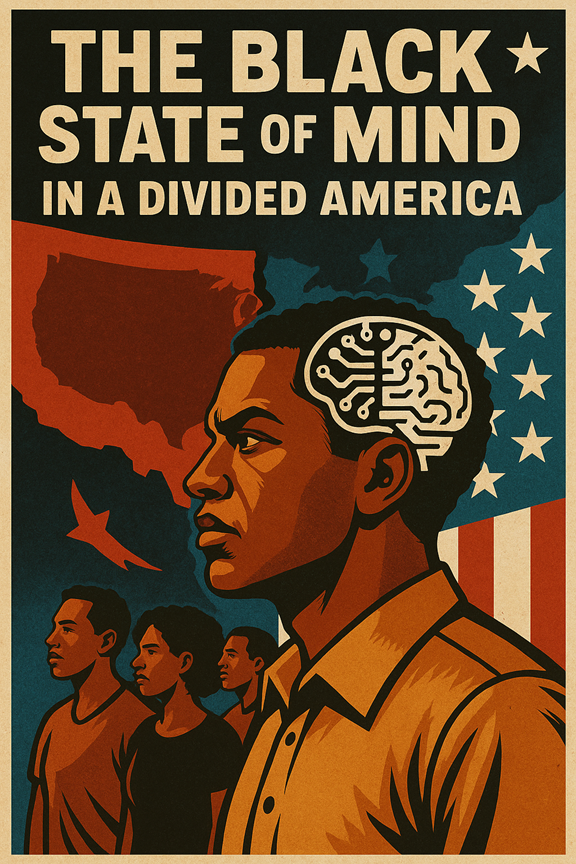
The Black state of mind today is shaped by an acute awareness of division – political, racial, and economic, and a persistent questioning of whether the American promise still applies to us. Pew’s findings show that 82% of Black adults say Black people are treated less fairly by the criminal justice system, and discrimination is described as “widespread” across employment, policing, housing, and education. These are not anecdotes; they are patterns supported by data.
Yet beneath this anxiety lies something else: clarity. A growing recognition that the struggle has entered a new phase – one in which information, technology, and the emerging power of artificial intelligence will determine whether minorities advance or fall further behind. And the stakes could not be higher.
The reality is we are living in two Americas; Black Americans and immigrants often experience a different America than the one proudly advertised to the world. While one America thrives on innovation, prosperity, and political influence, the other – our America, is still fighting for recognition, access, and opportunity.
Pew reports that 70% of Black adults say their race is central to how they experience life in the U.S., and that experience is often defined by barriers others never encounter. Economic disparities remain staggering. Wealth and health gaps persist. Educational inequalities deepen. And trust in government institutions is disturbingly low.
Pew’s research further reveals that nearly 60% of Black Americans believe their local political leaders do not care about the needs of Black communities. That feeling of abandonment is shaping a new, uneasy psychology, a worldview shaped at the intersection of hope and exhaustion.
Why This Moment Is Different, And More Dangerous!
We are not just confronting the old battles of racism and injustice. We are confronting them in an era of weaponized misinformation, hyper-partisan politics, economic instability, and rapid technological change that threatens to widen the divide.
Pew shows that almost half of Black adults believe racial progress has stalled, while an increasing share believes the U.S. is becoming more racially divided. This is a dangerous trajectory.
And while we have never lacked courage or creativity, access to the tools of the future, capital, networks, and now digital technologies creators, we lock in the same disparities for another generation. If we stay only consumers while others become creators, the future remains uneven.
We must reimagine a new frontier and create solutions rooted in innovation. Empowerment in this era will not be won through protest alone. It will be won through proactive participation in the technological revolution unfolding before us.
Artificial Intelligence, when understood and applied skillfully, can become a crucial equalizer in closing the knowledge gap.
Pew notes that Black Americans are among the most hopeful that technology can reduce racism yet remain among the least likely to have access to advanced digital tools.
AI can: support academic achievement, strengthen financial literacy, assist small business, provide mental health support, and offer expert-level problem solving.
This New Frontier represents 21st century empowerment, which can only strengthen our Civic Power, especially in this era of misinformation where our communities need Clarity; AI can add clarity to voting laws, policy changes, government actions, legal terminology, and misinformation strategies. Acquiring this level of political literacy is a survival skill which is necessary for our economic mobility, the incontestable truth is that Artificial Intelligence is democratizing entrepreneurship. Almost everyone has a smart phone, match that with a willing mind and the drive to succeed you can create a business plan, create marketing strategies, use automation, learn high-value skills and reach overseas markets.
Let me repeat for emphasis, technology by way of AI is levelling the playing field, now we need to step on it! Now we can tell our stories while we preserve and amplify our narrative! Finally, we can tell our stories with much less interruption, retain our oral histories, install digital archives, set up educational platforms and launch independent media.
Ownership of our story is ownership of our future! Use AI not only to compete, but to leap ahead! Learn the tools people, master the technology, empower our children, grow your business, protect your community, so let me repeat, use AI – not only to compete – but to leap ahead!
The Black state of mind cannot remain indifferent, or fearful or frustrated. It must evolve into a state of preparedness, ownership, and strategic advancement! America may be divided – but we do not have to be defeated.